


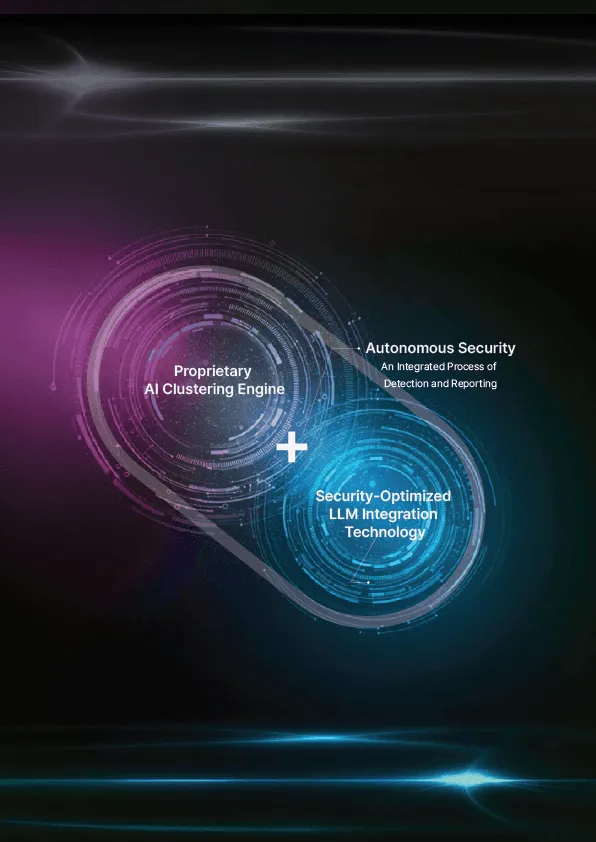
Autonomous Security
True autonomous security, powered by AI from detection to analysis and reporting.
It detects even unknown, new, and emerging threats in real time, minimizing human intervention and preserving the essence of security.
Mythos-style vulnerability discovery AI quickly identifies vulnerabilities and logical flaws that could be exploited in attacks, and attack-oriented AI agents automate reconnaissance, intrusion, lateral movement, and data exfiltration.
ClumL's AI clustering and LLM-driven autonomous security offer a unique answer to the security threats created by AI.
Without unnecessary UI embellishments, ClumL stays focused on the essence of security through autonomy.
As a leader in autonomous security, ClumL is ready to lead the global market.
Autonomous Security Capabilities of Clumit Security
Clumit Security combines ClumL’s proprietary AI clustering engine, built with globally competitive technology, and security-optimized LLM integration to enhance both the accuracy and efficiency of security operations.
By reducing the resources consumed by repetitive tasks, it creates a new environment where security teams can focus on strategic decision-making and response, realizing the vision of true autonomous security.
Proprietary AI Clustering Engine
The core intelligence of autonomous security, capable of capturing even the flow of threats.
The AI Clustering Engine detects new and emerging intrusions in real time. By identifying multi-dimensional behavioral patterns in unstructured raw data, it uncovers attacks that legacy detection systems often miss.
Real-Time Comprehensive Traffic Monitoring
Monitors inbound, outbound, and lateral traffic to address multi-path threats such as lateral movement and data exfiltration.
Security-Optimized LLM Integration Technology
Working in tandem with generative LLMs, the system analyzes and reports detected threats in real time.
This gives administrators and SOC analysts an intuitive end-to-end view of threat activity, enabling faster judgment and more effective response.
Self-Learning Model Optimization
The model continuously adapts to changes in the network environment, automatically improving sensitivity and detection accuracy to stay effective as conditions evolve.
ClumL’s Innovation: AI Clustering + LLM
- LLMs alone cannot detect threats → ClumL integrates LLMs only with validated detection results from AI clustering.
- Attempting detection with LLMs alone leads to unsolvable challenges: excessive cost and resource consumption, physical limitations, and accuracy issues.
- LLMs are not standalone threat detection engines. ClumL combines LLM analysis only with anomalous behavior validated by AI clustering, managing cost, accuracy, and physical limitations together.

Cyber Threats Solved by Autonomous Security
The Need for Autonomous Security
Autonomous Security minimizes human intervention and allows systems themselves to predict, detect, analyze, and respond to cyber threats autonomously.
It shifts the security paradigm from “after-the-fact response” to “proactive prevention” and “adaptive resilience.”
Known threats only
- Signature-based detection is vulnerable to unknown threats such as zero-day attacks.
Slow response speed
- Automated attacks can compromise systems in seconds or minutes, far outpacing human responses.
Limited learning ability
- Predefined rules and playbooks cannot adapt to new attack techniques.
Alert fatigue
- Tens of thousands of alerts per day overwhelm small teams of analysts.
Intelligent Threat Detection
- Detects unknown and emerging threats with AI/ML technologies
Real-Time Response Capability
- Automates detection through to response, drastically reducing response time
Continuous Learning & Adaptation
- Learns new attack patterns, enabling defense systems to evolve autonomously
Reducing Workforce Burden
- Addresses the global shortage of ~4 million cybersecurity professionals with an efficient alternative
Comparison: Autonomous Security vs. Traditional Approaches
Just as autonomous driving allows AI to handle most actions with only minimal human intervention, autonomous security enables AI to manage threats in real time—while expert judgment is applied only when necessary.
